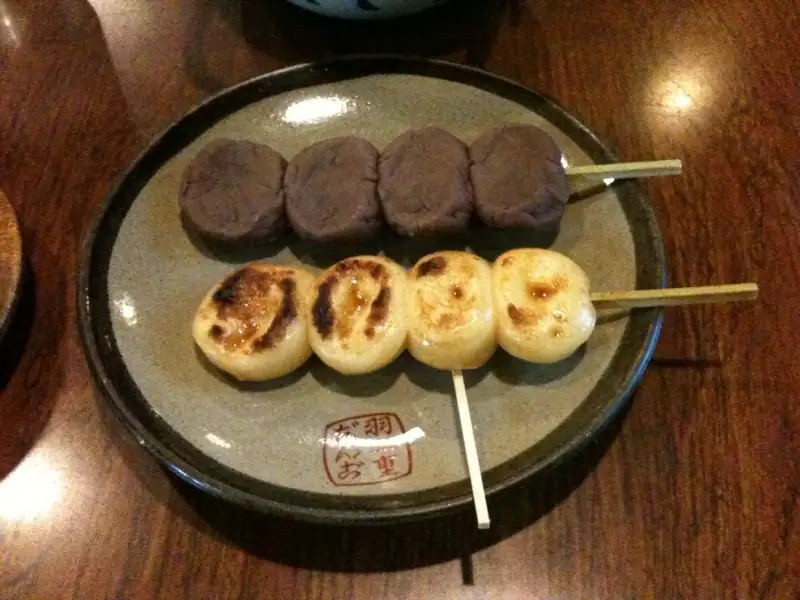
Habutae Dango (main shop)
In Japanese: 羽二重団子 本店
Est. 1819
Habutae Dango is a dango (rice dumplings on a skewer) shop on Imozaka slope in Nippori, Tokyo, open since 1819. Its dumplings were said to be as fine as habutae silk, and the name became that of the sweet and the shop. It makes two kinds, wrapped in smooth bean paste or grilled with soy sauce, and you can eat in.
- What to try
- Habutae dango(bean paste and soy-grilled)Soseki monaka
- Address
- 5-54-3 Higashi-Nippori, Arakawa-ku, Tokyo
- Getting there
- About a 3-minute walk from Nippori Station (JR and other lines)
- At the shop
- Eat inTake out
- Founded
- 1819
- Era
- Edo period
- Food
- Sweets café
About Habutae Dango (main shop)
In 1819 the founder opened the Fuji-no-ki teahouse on Imozaka slope. Its dumplings were first called Imozaka dango. They became known as being as fine as habutae, a smooth silk, and that word became the name of the sweet and later of the shop. A ranking of noted local goods from around the Meiji Restoration lists Imozaka habutae dango. The current head is the seventh generation.256
The dumplings appear as Imozaka dango in Natsume Soseki’s novel I Am a Cat and in Masaoka Shiki’s Dokanyama. Izumi Kyoka, Tayama Katai and Shiba Ryotaro also wrote about them.23
The rice flour is ground to a set coarseness from Haenuki rice grown in Shonai. It is kneaded with hot water, steamed, then pounded in a mortar with a mallet. More pounding makes the dumplings smoother, but too much turns them to paste, so the pounding is judged with care. The dumplings are flatter than usual. For the anko version, each one is wrapped in smooth bean paste made from Hokkaido azuki beans and coarse sugar. The grilled version is dipped in raw soy sauce and grilled twice, and its dough is made a little firmer so the sauce does not break it.25
The main shop was rebuilt and reopened in May 2019. The high-ceilinged room has about 20 seats at tables and benches, and old ledgers from the early years are on display. The red and blue stones and water feature from the old garden were kept in a small courtyard garden. The shop grounds also have a small Inari shrine, Fuji Inari Daimyojin.25
It is about a 3-minute walk from Nippori Station. The shop stands at the corner of Imozaka, on the road between the gate of Zenshoji Temple and Yanaka Cemetery.125
History
Lineage
- Fuji-no-ki teahouse1819
- Habutae Dango7th generation
Drawn only from what the sources state.
- 1819
The founder opens the Fuji-no-ki teahouse on Imozaka.
- 2019
May: the rebuilt main shop opens.
At the shop
Compiled by our editors from public sources. We warmly welcome corrections from the shop.
Walks including this shop
Nearby
Same food
When this shop first opened
1819
207 years since.
- 1802The first volume of Tokaidochu Hizakurige appears
- 1819Founded
- 1853Perry's ships arrive at Uraga
- 2026Today
Each event on the timeline is checked against a source.
See sources
1802: 静岡県立中央図書館「温故知新」十返舎一九と『膝栗毛』; 1853: 外務省「六月三日ヨリ十二日迄異国船進退之図」解説